

Now that Christmas is almost upon us, it is fitting that we turn our attention to the words of Christians who are doing their best to spread the message of their deeply cherished beliefs about the true meaning of this holiday season:
"There is nothing Christian about Christmas. Sure, religion has tried to make it appear Christian, but anything like CHRIST must line up with the Word of God and Christmas doesn’t. It is full of lies and hypocrisy, from Santa to the giving of gifts to the nativity scene…. I know that many Christians say that they disassociate themselves from all of the lies and paganism of Christmas, but that, my friend, you can’t do. If you take the lies and paganism out of Christmas, you'll have no Christmas, for that’s what it is made of."
(For more, if that's not enough, see here.)
Such thinkers abound in chat rooms and churches alike. What inspires them to hold these heartwarming beliefs? Usually, their supporting arguments are something like the following:
- Jesus was almost certainly not born on December 25. December 25 was originally a pagan holiday that the church attempted to Christianize.
- Traditional symbols like mistletoe, holly, the Yule log, evergreens, and the Christmas tree were originally pagan symbols and/or deities.
- There is no Biblical injunction to celebrate the birth of Jesus, and the Lord forbids us to add to His commands.
Although such people seem to have cornered the market on the spirit of Ebenezer Scrooge, allow me to be the first to cry, “Bah! Humbug.” Let’s examine the merits of these arguments:
1. "Jesus was not born on December 25." Why, of course not. Neither was Dr. Martin Luther King, Jr. born on the day we celebrate Martin Luther King Day, but that doesn’t stop the American people from celebrating the memory of a great man.
We could attribute the neglect of Dr. King’s actual birthday to some racist conspiracy in Washington, that is, if we liked to attribute the worst possible motives to people. But it’s more reasonable to say that it was put where it is because, perhaps, Americans are more likely to celebrate a holiday that involves a three-day weekend. We hardly need to attribute evil motives to anyone to explain that.
In the same way, putting Christmas on December 25 could be a way to incorporate pagan idolatry into the church, or it could be:
- Putting the celebration of Christ on a convenient day when all the pagan neighbors were celebrating anyway.
- Providing an alternate celebration so “weaker brothers” would not be tempted to lapse back into paganism. (Ever see a church hosting a "harvest party" on Halloween?)
- Placing the celebration of Christ’s birth nine months after the day in the liturgical calendar that commemorates the Annunciation (March 25). That day, as it happens, was never a pagan holiday but was chosen because it was near the date of the Crucifixion. (Our forefathers believed these things would have happened in round numbers.)
When a simple explanation covers all the facts, conspiracy theories are automatically disqualified, cut from the list by Ockham’s razor. There are plenty of reasons to celebration Christmas on December 25 that do not involve any concession to paganism. You may now return to decking your halls with boughs of holly—oh wait; we’ve forgotten numbers 2 and 3.

2. "Many elements of the Christmas celebration are actually pagan symbols." You wouldn’t be using that holly to deck your halls if you knew what the pagans did with it. Want to hear what the Druids believed about pine trees? And no prizes for guessing what mistletoe symbolized. How can a Christian endorse such elements of paganism?
Sounds pretty impressive, and doubtless packs a strong emotional wallop, until you reason it through. Let’s put it in as simple terms as possible:
- Holly is not a pagan symbol. It is a plant.
- A pine tree is not a pagan symbol. It is a plant.
- Mistletoe is not a pagan symbol. It is a plant.
- God made plants.
Plants are not forms of communication, which means plants don’t mean anything unless you choose to associate a meaning with them. The meaning is not part of the object but something a cultural group intentionally associates with it.
The meanings the ancient pagans gave to plants are doubtless at odds with Christian beliefs, but it hardly follows that the plants must have those same associations hundreds of years later for people in different cultural situations. When I give my wife a red rose, I am not saying that I support the house of Lancaster instead of the Plantagenets, even though that’s precisely what it would have meant had we lived in 15th-century England. (Bonus points to anyone who knows who the Plantagenets were.) Associations change easily and are almost entirely subjective. As for us, most Christians agree that “Only God can make a tree.”
Of course we should not worship God with sinful practices that are borrowed from idolatry, as you might have read in Deuteronomy 12. But that is not what’s at issue here. Nobody I know of is celebrating Christmas with present-day pagan symbols such as pentagrams, unless they're extremely religiously confused. Plants aren’t inherently sinful, nor were they created to be used in pagan worship or any other sinful practice. The ancient pagans simply hijacked God’s creation and used it for their own purposes. That’s their problem, not ours. It wasn’t the fault of the plants, and there’s nothing sinful about the plants themselves. Deuteronomy 12 simply doesn’t apply here.
 Furthermore, the Christians who argue that we should avoid everything that has roots in paganism are being terribly inconsistent. They have overlooked a significant piece of our culture that not only comes from ancient pagan worship but (unlike the plants) still shows the association. All the names of the days of the week are derived from pagan deities—Wednesday is “Woden’s day,” Thursday is “Thor’s day,” Friday is “Frey’s day”—except for Sunday and Monday which come from the worship of the sun and moon. Yet even the most anti-Christmas Christians talk about holding prayer meetings on Wednesday or Saturday. Why don’t they consider that even more sinful than putting up a Christmas tree?
The answer is that nobody today, but nobody, says “Saturday” and means “the day which we have dedicated to the worship of Saturn.” Even though that is obviously part of the word’s etymology, an etymology is a word’s history, not its definition. The definition must be based on the way the word is used today, and today’s users do not include Saturn-worshipers. Thus, when the culture changes significantly, even an obvious pagan reference can become perfectly benign. If Christians can say “Saturday” with a clear conscience, and we obviously can, we certainly don’t need to worry about Christmas trees.
3. “There is no Biblical command to celebrate the birth of Jesus, and the Lord forbids us from adding to His commands.” This is an argument that does seem to carry a bit of weight, and undeniably has a strong emotional pull among Christians who claim to believe in Sola Scriptura. Who wants to be guilty of adding their own ideas to God’s Word?
Many Christians would be content to observe that many other things, like cars, toasters, and banana cream pie, aren’t mentioned in the Bible either, and hardly anyone has any scruples about using them even in church. The Bible after all is not a manual of how to create a culture, but an inspired record of how God has revealed Himself to people throughout the flow of history.
I’ve got a better argument which I’ve never seen used on the subject, so watch carefully. In John 10:22-23, we see that Jesus went to the temple in Jerusalem when “the Feast of Dedication took place.” Which feast is that? You will search the Old Testament in vain for any reference to it. In Hebrew it is called “Hanukkah.”
As those familiar with Jewish culture know, the festival of Hanukkah was started c. 165 B.C., in the period between the Old and New Testaments, to commemorate the rededication of the temple (long story, see under “Maccabees.”) The Old Testament contains no mention at all the holiday or the historical events that led to its creation. (Hanukkah did not originate until after the O.T. canon was closed.) The holiday was not ordained by God, but Jesus still celebrated it.
If the Lord Jesus Himself was comfortable celebrating a religious holiday that was not found at all in canonical Scripture, surely the argument that Christmas as a holiday cannot be found in the Bible carries absolutely no weight whatsoever.
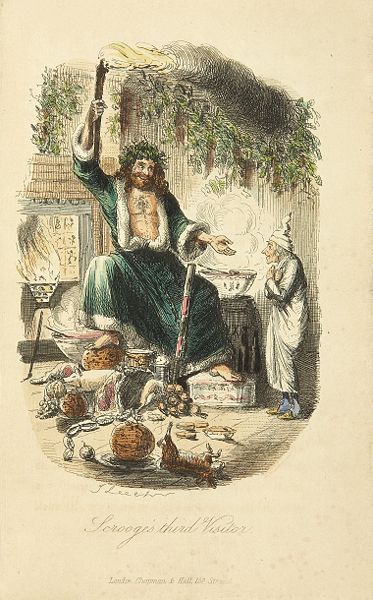 In short, Christmas passes the test. All these arguments against it are nothing but (oh, how I enjoy saying this word) humbug! It is high time for this anti-Christmas sentiment to be boiled in figgy pudding and buried with a stake of holly through its heart. Bah! And again, humbug!
All that being said, however, there are still plenty of things about Christmas for Scrooge-minded Christians to legitimately object to. The rampant commercialism and blatant materialism are undeniably contrary to the spirit of the Gospel. Santa Claus may be harmless for those who trace his lineage back to the generous St. Nicholas of Myra, but for others he can become “replacement religion,” a convenient substitute for the Christ of Christmas. And who hasn’t been fed up with the loathsome retail rush and frenetic schedules that crowd all the time and energy out of the season?
God help us, every one.
I’d give an inspiring message on what we should do here, but I think it’s fairly obvious. Stop and smell the peppermint. Focus on the giving. Remember the first five letters of the holiday. And remember that this may be the best opportunity you’re likely to have all year to share the message of Christ with your neighbors. Don’t waste it on petty squabbles about mistletoe.
In other news, a poll has found that “only 5 percent of Americans are offended by the phrase ‘Merry Christmas,’ while 46 percent are offended by the phrase ‘Happy Holidays’ when spoken by someone who is afraid someone else will be offended by the phrase ‘Merry Christmas.’” (QT, Chicago Sun-Times, Dec. 17th 2006)
And a happy Hanukkah to you too.

Don’t forget Purim. Purim is another festival that the Jews created but the Bible never condemns them for acknowledging the salvation that came to the Jews on that day.
@ProudToBeAChristianFruitcake: Excellent point, in fact a point that helped at least one person I know over an aversion to Christmas. Purim of course has many activities that are fun for children but that help teach the lesson of God’s deliverance– not unlike Christmas as well.
Excellent points on all counts. This has been an ongoing debate amongst many I know and you address their issues with it quite well, I think.
I keep a binder with information about the feasts, as well as about holidays of various sorts. I would like to print this out to read to my family and then put in my binder.
I would also like to be able to copy it to give to some others I know. Would it be OK to do that? I would, of course, give you full credit and give the location.
Yes, of course. I’m always glad when someone can spread the good word! I appreciate your reading, commenting, and sharing.
Thank you! Keep those thoughts coming!
Thank you! I read your other post on Christmas trees and followed the link over here! This is awesome and so helpful! I’ll probably have to re-read it again and again! It frees me up to not feel guilty just because my Dad has followed and taught other false teachings on Christmas! I love Christmas and so thankful to say goodbye to the guilt on Christmas!
Have you written on the bible and birthday celebrations?
~ Ali
Ali- I’m so glad it helped! I haven’t written on the Bible and Birthdays both at once (though I once wrote an article about the Bible on my Birthday), but I might do it sometime if you think it would be helpful. In the meantime, you might like this one: God’s Little Instruction Book.
FYI, the Birthday post is here: Reader Question: Beagles, the Bible, and Birthdays.
Eric, you miss the two key points of the issue. 1.Our worship and service to God is to be “…in Truth.” Hence, it is not ours to just come up with ways of worshipping God. Scripture nowhere directs or suggests that it is proper or good to have an annual remembrance of the birth of Jesus. That, and an acknowledgement that the apostles, and no church of the first 4 centuries had any semblence of a yearly Jesus birthday celebration, requires the beliver of today to find out how this tradition came to be. 2.The existance of Saturnalia celebrations even before the birth of Christ, with so many of the same customs and practices of contemporary Christmas, point to more than just a “fall festival” kind of diversion, but rather a syncretistic exercise of significant pagan basis. Plants are made by God – Yes. But when one uses a particular plant in a particular way, the same plant, way, and time of year as a blatanly pagan celebration, that one is undeniably associating with the pagan holiday whether he admits it or not.
Dedication and Purim are at the least remembrances of vctories which the people had accomplished for the God of Creation. Saturnalia, however, isn’t even close to anything to do with God.
The link is just to show that I am not making up the historical info.
http://www.simpletoremember.com/vitals/Christmas_TheRealStory.htm
@Keith: Two textbook logical fallacies, I’m afraid. First, to say “The Bible doesn’t say to do X, therefore it’s wrong to do X” is arguing from silence. It could just as easily be turned around: If it’s really so important for us to avoid it, why doesn’t the Bible say so? The silence proves nothing either way, so it’s at best a Romans 14 matter of conscience. Second, if I use a tree God made to celebrate the incarnation of Christ, then I’m not using it “the same way” pagans did, since they didn’t worship Christ. That fallacy is false analogy or guilt by association. Compare Peter’s vision in Acts 10–“Do not call anything impure that God has made clean.”
“One man considers one day more sacred than another; another man considers every day alike. Each one should be fully convinced in his own mind. He who regards one day as special, does so to the Lord. He who eats meat, eats to the Lord, for he gives thanks to God; and he who abstains, does so to the Lord and gives thanks to God.” (Romans 14:5-6). That’s all it’s about, really.
So if I use holly in a topiary or hedge (even as an all year round centerpiece), as a STRICTLY SOCIAL thing, (devoid of yule, saturnalia or even “pointing to Christ” or whatever) am I worshipping false gods or am I just using it socially? If I use writing paper with ivy borders as a strictly social thing am I worshipping the god of wine? I for one use holly sprays in little centerpieces during winter but for the same reason I use daffodils and roses in the spring. Would it be okay for me to use holly in the spring, summer and fall but not in winter? So then should I remove my topiary from sight as soon as December rolls around and then place it back quickly as soon as Jan 1st passes?
Eric, I did not say, “if the Bible doesn’t say X….” Your point would be correct if that had been my arguement. The Bible does say, “they that worship Him MUST worship in …Truth.” Locative of sphere, meaning that the body of “Truth” is the source of doing worship to God. The Bible also says that worship based on traditions of men rather than Scripture is “vain” and makes the Scripture of “no effect.” (Mark 7:1-13) Thus, when it comes to worship, Scripture is the limit or means. Note – WORSHIP! not menus or technological advances for daily life.
As for your logic, can I then wear a swastika on my arm, say that I mean it something different from its historical identity, even assign a spiritual meaning, and claim that I am free of the association, just because I choose to say I am using it differently? If so, of what use is it to try to be “unspotted” from the world? I can just claim my own right to define anything as “not world.”
Keith,
A swastika is currently in use and, therefore, has current meaning. I would never use a swastika for that reason.
I do not know of anyone who goes down to the local “get your idol here” lot to buy a tree for Christmas. I know of NO one who bows to a tree, prays to a tree, tries to feed a tree. Therefore, a tree today is completely unrelated to a tree in the past. Sure, there might be some individual that does that…somewhere. But the common usage has no connection.
So far as truth goes…Yeshua WAS born. That is truth. In our culture, we celebrate birthdays…and not always on the actual day. In fact, there are children who are adopted from foreign countries whose actual birth dates may not even be known. That does not stop their adoptive family from celebrating their birthdays.
The Spirit of Truth dwells within us. He is quite capable of leading each one of us. We do not all see the scriptures in the same way. That is not a bad thing. The Holy Spirit will lead each one of us. The people referenced in Romans 14 were ALL believers. Yet, they interpreted the scriptures differently.
The issue is NOT how we interpret or understand scripture. The issue is to NOT judge another because their understanding is different than ours.
Scripture also says we MUST have a parapet on our roof. Do you have one on your roof? If not…why not? Scripture is pretty clear on that. It also talks about what real fasting is…yet I never hear that described in discussions on fasting. If you look at ALL the scriptures dealing with the Sabbath…I don’t know of any congregations who do those things. And I am not even talking about the day of the week!
What about the names of the days or months. Just because I call January “January” does not mean that I honor Janus during that month. Just as worshiping G-d on Thursday does not mean I honor Thor on that day!
Where do we draw the line? For you, the line may need to be drawn to make a smaller circle than it needs to be drawn for someone else. That is because the Spirit knows our hearts. He knows what will tangle us up, tie us down and hinder our walk with Him…which is the most important thing to Him of all!
Is one right and one wrong? No! Romans teaches us that both can be right! What is important is that each one be fully convinced about what he/she is doing for each one of us will stand before the L-rd for our own lives only.
Shalom and blessings to you, Keith.
But according to Keith, God does not “know” our hearts and might point out that King Uzzah touched the Ark with an “good heart and mind” and God struck him down. Or when Nadab and Abihu offered the strange fire with a “sincere heart”, God burned them up. “See?” says Keith. God does not “know” our heart. He is only waiting to dish out punishment.
It has been three years since I wrote that.
I do think we need to do things G-d’s way. I also think we need to be sensitive to those who have not yet come to that conclusion. G-d does know our hearts. He knows when we are merely ignorant and when we are purposely being “blind” to the truth. He knows when we are rebelling against His ways. That is His domain, not mine.
I prefer to celebrate the biblical feasts that He gave us, but I will not judge another. Where does it say in scripture that Uzzah (who was not a king, by the way) had a “good heart and mind”? G-d said not to touch the ark. Uzzah disobeyed. He suffered the consequences. In fact, the ark should never have been on a cart to begin with. It was to be carried only by priests and only with poles. The whole thing was just plain wrong.
I think Keith’s point is well taken and we are too quick, I believe, to dismiss G-d’s laws in favor of what we are comfortable with and want. I just won’t judge another.
I never said we shouldn’t obey God’s laws. I’m just pointing out the illogic in a legalist’s argument.
Abigail, let me get this straight. If I use peppermint plants around my home am I worshiping Hecate? In case you didn’t know, peppermint is used in divination and worship of Hecate by neopagans. See here:
http://herbalriot.tumblr.com/post/63721992765/magickal-uses-of-peppermint
http://paganwiccan.about.com/od/herbalism/ss/Magical-Herbs.htm
http://www.spellsofmagic.com/read_post.html?post=218961
And if I have roses or nettle does that make me a pagan too?
http://recreationalwitchcraft.tumblr.com/post/123741774482/50-magical-uses-for-roses-roses-are-one-of-the
http://herb-magic.com/rose-petals.html
http://herbalriot.tumblr.com/post/52215694548/the-magickal-uses-of-stinging-nettle
So does that mean if I have peppermint plants at my kitchen door am I secretly inviting Hecate in my home? Or if I have a hedge or topiary of holly all year round (including wintertime), does that mean I worship the holly king? If one is worshiping another god just by using something that pagans use religiously, why do you use wreaths at your loved one’s funerals when wreaths were associated with Jupiter? See Acts 14:13 “The priest of Zeus, whose temple was just outside the city, brought bulls and wreaths to the city gates because he and the crowd wanted to offer sacrifices to them.”
You may say that Yeshua and His Apostles did not use holly or peppermint but neither did Yeshua and His Apostles use wreaths at their loved one’s funerals.
Abigail, let me get this straight. If I use peppermint plants around my home am I worshiping Hecate? In case you didn’t know, peppermint is used in divination and worship of Hecate by neopagans. See here:
http://herbalriot.tumblr.com/p…
http://paganwiccan.about.com/o…
http://www.spellsofmagic.com/r…
And if I have roses or nettle does that make me a pagan too?
http://recreationalwitchcraft….
http://herb-magic.com/rose-pet…
http://herbalriot.tumblr.com/p…
So does that mean if I have peppermint plants at my kitchen door am I secretly inviting Hecate in my home? Or if I have a hedge or topiary of holly all year round (including wintertime), does that mean I worship the holly king? If one is worshiping another god just by using something that pagans use religiously, why do you use wreaths at your loved one’s funerals when wreaths were associated with Jupiter? See Acts 14:13 “The priest of Zeus, whose temple was just outside the city, brought bulls and wreaths to the city gates because he and the crowd wanted to offer sacrifices to them.”
You may say that Yeshua and His Apostles did not use holly or peppermint but neither did Yeshua and His Apostles use wreaths at their loved one’s funerals.
Don, I have no idea why you are addressing this to me. What have I written that you are responding to? Perhaps, you need to reread what I wrote…very carefully. 🙂
Hi Abigail, I’m just asking questions generally. But you did imply that you agreed with the pro-Christmas as well as the anti-Christmas stance in one of the comments.
I believe we each stand before G-d and will be held accountable for our actions. There is actually scriptural support for, as well as against, many of the arguments surrounding whether to celebrate Christmas. There is another issue, of course, which is about how to celebrate and there are many arguments people have for what they do, or don’t do. I am not going to judge another over it. If scripture is very clear about something, I will point it out if I sense the person is ready to hear it. Outside of that, I pretty much leave it alone.
I have no idea why you wrote all the other stuff to me. 🙂
@Keith– Well, you did say “Scripture nowhere directs or suggests…” but since you concede the point I won’t belabor it.
I think you are missing the broader context of John 4. “Truth” in John’s gospel is defined as “Jesus” (John 14:6–“I am… the truth”), not a rules-based reading of Scriptural “limits”. The point of John 4 is that in Christ there is a union between “God is Spirit” and “the true worshipers,” thus we must “worship in spirit and truth”–a worship that is pointless unless we “worship the Father.” In Mark 7, the “traditions” were directly contrary to the word of God–“you nullify the word of God by your tradition”, v. 13– but as we’ve agreed, the Bible is silent here so it can’t apply to this question. That could be turned around, though: the pagan tradition is that trees are idols, but the Bible clearly states that they are made by God!
The point about symbols I already addressed in the article above. “…it hardly follows that the plants must have those same associations hundreds of years later for people in different cultural situations.” Swastikas actually demonstrate this remarkably well–originally, they were symbols of Jainism, an Indian religion that teaches nonviolence to all living things. If they can depart from their former meaning that dramatically in just the past 80 years, why can’t trees? The relevant question is what a symbol means in our given culture today. If there were any tree-worshiping pagans in my neighborhood, I can see how it might be an issue to keep them from stumbling–but, as Abigail has pointed out well, there aren’t.
Keith; here’s a little mind game that might help you see the argument a bit differently:
You know that goofy saying “May the fourth be with you” that goes around Facebook every year next to pictures of Luke Skywalker? Let’s just say it becomes a popular tradition for people to go all out and dress like Star Wars characters, set out butter sculptures of Yoda and worship the ‘force.’ Of course, no Christian would actively take part in this because we should worship no other Gods before Him.
Now, imagine if you will, that all this is going on in some country somewhere where Christianity is non-existent. (How this apparently undeveloped country escaped the watchful eye of modern missionaries and yet somehow got their hands on a science fiction film and all the equipment necessary to watch it I don’t know, but use your imagination.)
This has been going on for years and is deeply embedded in their culture. It is their absolutely favorite celebration. When the first missionary gets there and several people switch over to Christianity, (as opposed to, you know, force worship) they wonder what to do with this celebration. Some pretend absolutely nothing is going on, a few who you may consider somewhat misinformed continued joining in the celebration (minus the force worship of course) which actually leads to some interesting evangelical opportunities, but the majority stay at home cowering in their closets as those of old may during All Hallow’s Eve. One May fourth however, a young man is reading his Bible and stumbles across a verse telling him that he has not been given a Spirit of timidity, but of courage. This young man is filled with (presumably) holy inspiration and goes around collecting the rest of the cowering believers (and some who are not cowering) and presents them with a proposition: “Let’s stop acting so freaked out and just dedicate this day to the Lord. After all, if we’re going to be avoiding society anyway, why not worship him while we’re at it and maybe have a time of fellowship!”
So the little group of believers begin to meet and worship on that day, and they decide that “May the Fourth” is as good a name as anyway, so long as they tack onto the end “May the Fourth of GOD be with you” instead of just leaving it as it is. Time thunders on and their little group of believers becomes a bigger group. In this group are a few people who really liked some of the, yes, ‘pagan’ traditions. (Some of them were incredibly renowned butter sculptors, you see.) They ask if they can make a butter sculpture and proceed to carve out the scene of Jesus hands outstretched, stopping the storm. (This was actually a greatly convenient thing for them to do, because it reminded the “Jedi” of the force, though it was attached to an unfamiliar face. It led to even better evangelical outreaches.)
Time rushes on and now Star Wars is a completely unknown thing in their culture and, in fact, almost worldwide. Until one day Mr. Afraidofgrace was surfing Netflix and found an ancient video. It wasn’t hi-def, or even 3-D but it was something he had never seen before. He watched it, and followed a few links in the comments and found websites describing traditional May the Fourth celebrations. Mr. A freaked. He wouldn’t allow butter sculptures anywhere near his house, in fact, he switched to spray margarine just so there would be no resemblance whatsoever to butter. He didn’t leave his house and ignored people whenever they said “May the fourth be with you” (You see, everyone knew that it was referring to the force of God, so they shortened it, but of course, he knew that originally it hadn’t and felt as if they were raining down curses upon his head.) Mr. A spreads the word about this previously pagan celebration and speaks of the sin of butter, using such demonstrations from the Bible as Jesus last supper and how he wouldn’t want us to butter his body, now would he? Besides, it was a pagan symbol thousands of years ago!
Mr. Afraidofgrace’s movement led to many others being terrified, locking themselves into their houses, and totally ignoring the verse that the first young man had found. The arguments against May the Fourth celebrations? “Well, Jesus is in a force-like pose. Even though no one has seen that video, we really should guard against any association.” “Well, butter was once used to form a pagan symbol.” “Well, God didn’t say we should worship on May the fourth, now did He?” (No, he said we should pray continually, and isn’t that a form of worship?) The arguments for it? “Nobody knows about the video.” “It’s a great evangelizing opportunity” “God made cows which produce milk and cream which produce butter. God made everything clean.”
So…. why not celebrate God/Jesus ability to stop the storm? Nobody knows it was based on a pagan holiday (well, they do now, but no one’s actually celebrating that pagan holiday, now are they?). Why not set apart a special day to concentrate on a particular aspect of Christ?
Why not? If it’s your conviction, go for it, but it’s not your job to let us all know why it should be our conviction. Paul talks about us keeping our convictions between us and God and not trying to convince others. (I’m not trying to convince you, I’m trying to show a different perspective, but if you think I’m going against that verse, please let me know and we can deal with this post.) Go with your convictions. A sin against your conscience is a sin against God. However, it is not your job (or my job either) to convince others that your conviction is right and theirs is wrong unless it’s a black and white thing.
***********************************
Eric, I love your blog and some of your comments on Quivering Daughters. They really helping me through some major legalism issues I’m struggling with right now. (I actually went through the Christmas/Easter are pagan?! thing not too long ago. It helps that you quoted my favorite movie in the first post of yours I read (the great philosopher Inigo Montoya? I’m so there!) God has really been blessing me through this and I’d like to thank you for making yourself available to provide that blessing.
Your sister in Christ
Thanks for your very encouraging words, graceisbetter! That’s wonderful to hear. Also thanks for the very clever comment about the Christmas legalism. I’m glad you came by!
I’ve followed this post from your Christmas tree article and definitely you have some good arguments… actually, both sides do and I appreciate that everyone on here is sticking to discussing the issues, and not attacking. We must be fully convinced to follow our own consciences, and I’m still a little torn here but very appreciative of the discussion. Do you have an article on hallowe’en, or opinions? Do you follow the same thoughts there as you do about Christmas?
Thanks, April! I enjoy the good nature of my commenters, too.
On Hallowe’en, two very interesting articles I’ve read lately (not written) on it are here: “Jesus with His Lights Out on Halloween”, explaining why we need to use it as a time to show love to our neighbors (hint: get them really good candy!), and “Reclaiming the Reclamation”, by an Irish Catholic explaining the actual history behind its “pagan origins” and comparing it to a Christian theology of death.
Many (not all) of my thoughts above would apply, of course, though I’d switch out “the birth of Christ” for, maybe, “I will fear no evil, for thou art with me.”
Hi Eric, I loved the article, but I have a pound of guilt on me. There are two verses in Jeremiah 10 namely v3 and v4, that is causing me great grief. Isn’t “the cut tree” the result of “a craftsman with a craftsman with a cutting tool?” I mean isn’t the felled tree, the result of the craftsman with the cutting tool? Theses verses have wracked me with such an intense guilt I find difficult to live with. Please shed some light on this issue. Thanks in advance.
Hi Anon34 – Thanks for your comment! Sorry to hear you’re feeling so much guilt, but I hope I can put your mind at ease.
Even though it might sound like it to us from our cultural viewpoint, there’s simply no way Jeremiah would have been describing anything like what we recognize as a Christmas tree. He was describing the idol-worship of “the nations” (v. 2) around him at the time (think Ancient Near East c. 600 BC). If you look at pictures of idols from the time Jeremiah was writing — Here are some on Google — you’ll see that they were obviously made in several steps. First a tree was cut down, then a sculptor carved the wood into the shape of the idol, then a goldsmith plated it with gold, and so on. That’s the process Jeremiah was describing, not using trees as seasonal decorations.
Notice that some of the other descriptions Jeremiah gives don’t fit Christmas trees at all– for instance, “They must be carried, Because they cannot walk!” (v. 5). Idols were carried around in processions to be worshiped; Jeremiah points out that this shows they weren’t powerful enough to walk on their own. This makes no sense about Christmas trees; who tries to make them walk?
Even if it was the case that Jeremiah was describing something like Christmas trees, though, look specifically at the conclusion that he draws about it: “Do not fear them; they can do no harm nor can they do any good.” (v. 5) He’s not saying “Avoid anything that could possibly fit this description, because it’s evil,” but “Don’t be afraid of them. They’re not harmful; they’re neutral objects.” That’s the point I make in my article on Christmas trees. Just because pagans may have wrongly worshiped something God made doesn’t turn it evil; as God told Peter in Acts 10:15, “Do not call anything impure that God has made clean.”
In other words, if you like to decorate your home with things that God created for us to enjoy, you have absolutely no reason to feel guilty about it. I hope that helps!
Thanks (praise the L-rd) for that. It really lightened me. I do feel better. I like evergreens. I was reading through the comment thread and stumbled upon Keith’s comments and his reasoning. He said that if we used a particular plant in a particular time we are sinning. Every winter G-d decorates His trees with snow and icicles. YES! G-d decorates His trees DURING WINTER! With snow and icicles! Are we now to condemn G-d for decorating His own trees? Who did the pagans get winter from? From Nimrod? Really? Who did Nimrod get winter from? From G-d!
With regards to association Keith said,”one is undeniably associating with the pagan holiday whether he admits it or not.”
Really? So G-d is associating himself with pagan deities when He decorates His firs with snow and icicles? G-d created the winter solstice, Nimrod didn’t. Pagans got winter from Yah. It is Yah who makes snow and rain fall, pagan deities have no power to do such.
Now I know you will respond with some sarcastic comment saying,”so we can take temple prostitution and offer it to G-d, right?” or “how long does it take to lose pagan associations?”
A false comparison, since G-d creates trees and indeed decorates them with snow and icicles but He never created a brothel or temple prostitution. Regarding how long it takes to remove pagan associations, allow me to answer that question with a question. How long does it take to remove homosexual associations from a rainbow? According to your logic, if you merely associate yourself with a rainbow, you are identifying yourself with homosexuality “whether you admit it or not!”